
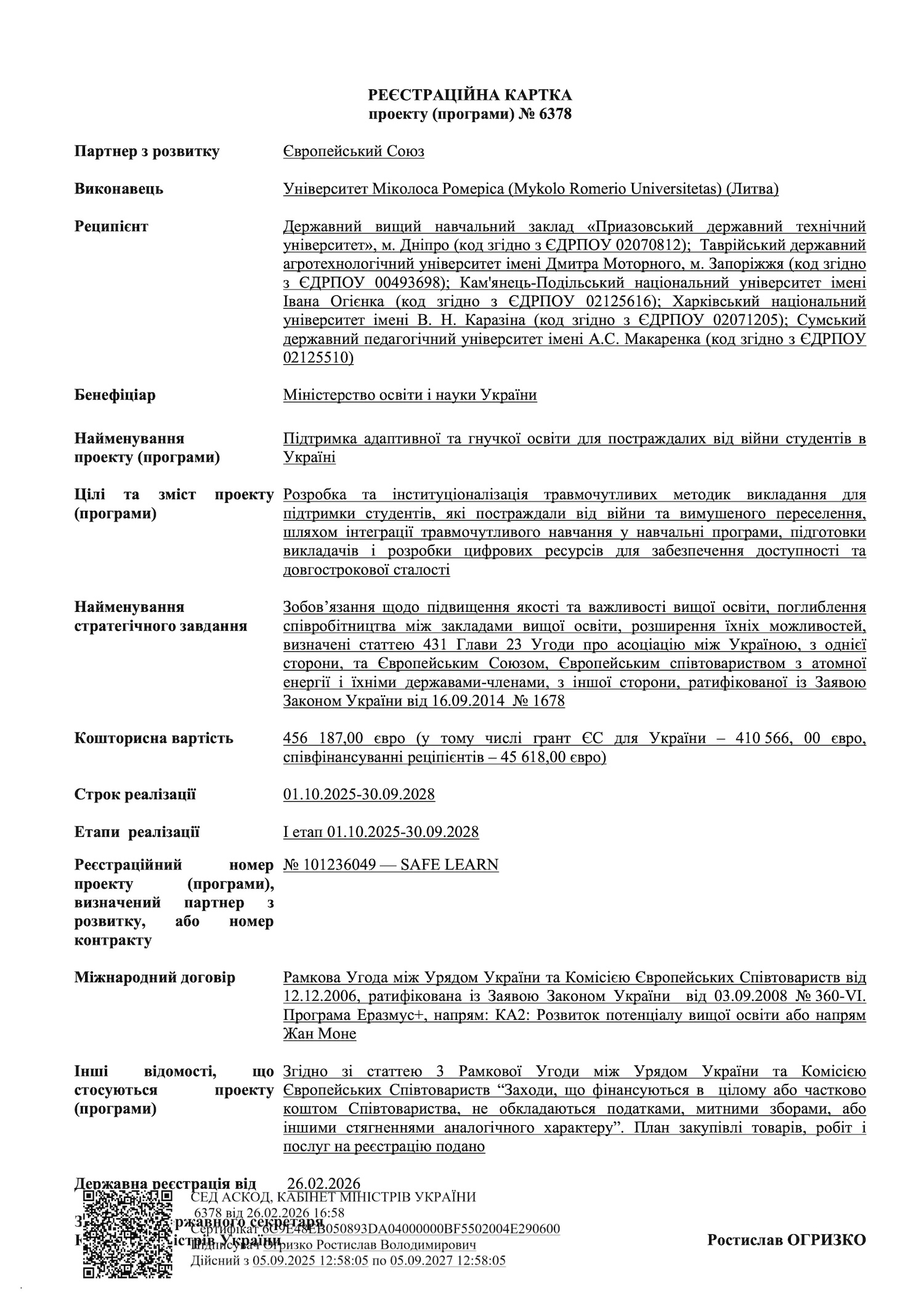
Supporting Adaptive and Flexible Education for War-Affected Students in Ukraine

Short project name: SAFE LEARN
Project ID: 101236049
Project implementation period: 01 October 2025-30 September 2028
EU funding programme: ERASMUS-EDU-2025-CBHE
Target group: students, teachers
Project Summary
SAFE LEARN aims to develop and institutionalize trauma-sensitive teaching (TST) methodologies to support students affected by war and displacement. The war has disrupted higher education, causing prolonged remote learning, forced relocation, and increased psycho-emotional distress. Ukrainian universities face significant challenges in maintaining academic continuity while addressing students’ trauma-related needs. SAFE LEARN introduces structured, evidence-based trauma-sensitive pedagogical approaches that foster resilience and engagement. The project unites a multinational and interdisciplinary consortium of European and Ukrainian universities to integrate TST into curricula, train educators, and develop digital resources to ensure accessibility and long-term sustainability. The project’s methodology includes developing TST strategies, training over 100 educators, piloting student-centred interventions, and establishing an Online Resource Center (ORC) for digital learning and psycho-emotional support. TST principles will be embedded across multiple disciplines. Institutional policies will be adapted to include trauma-sensitive education, creating a more inclusive and resilient higher education system. SAFE LEARN will strengthen Ukraine’s academic sector by enhancing students’ well-being, improving learning outcomes, and ensuring sustainable, high-quality education even in crisis conditions.
Project purpose
The purpose of the SAFE LEARN project is to support adaptive, flexible, and safe education for students affected by the war in Ukraine through the implementation of trauma-informed learning approaches, the development of digital tools, and the professional development of teachers aimed at creating an inclusive and resilient educational environment.
Tasks
- Development and Pilot Testing of TST Methodologies.
- Facilitator training course for UA university.
- Initial pilot training sessions in UA for target students.
- Evaluation of TST methodology effectiveness.
- Development of training modules “Learning to Learn” using TST principles for target students.
- Analysis of the impact of TST interventions on student resilience and academic performance.
- Development of the ORC platform with quickly find relevant materials and upload with digital materials and interactive tools constantly.
- Design of the Strategy of TST integration for university-level application (STSTI).
- Organisation of annual international summer schools on TST for teachers.
- Implementation of a TST training for teachers as retraining course.
- Leadership training on integrating trauma-sensitive approaches in university management.
The coordinator:
Mykolas Romeris University (MRU), Lithuania
Partners:
- Silesian University of Technology, Poland
- Sveriges Lantbruks Universitet , Sweden
- Center of Advanced Internet Studies , Germany
- State Higher Education Institution “Pryazovskyi State Technical University”, Ukraine
- Dmytro Motornyi Tavria State Agrotechnological University , Ukraine
- Kamianets-Podilskyi Ivan Ohiienko National University , Ukraine
- V. N. Karazin Kharkiv National University , Ukraine
- Sumy Makarenko State Pedagogical University , Ukraine
Expected results:
- Strategy for the Integration of TST for implementation at the university level (STSTI).
- ORC platform with functionality for quick search of relevant materials and continuous uploading of digital resources and interactive tools.
- Learning to Learn training modules based on TST principles for target students.
- Facilitator training course for Ukrainian universities.
Mechanisms to maintain and expand the project’s results:
- Each university will formally integrate TST methodologies into its curriculum, ensuring that teachers are continuously trained in TST.
- Online Resource Center as a digital platform will serve as a hub for trauma-informed education materials, teacher training guides, and digital resources.
- Universities will train future trainers, ensuring that TST methodologies are continuously disseminated.
SAFE LEARN aligns with existing EU education policies on inclusive education, mental health support, and digital learning. HE teacher training sessions will provide a sustainability for continued academic exchange and training on trauma-sensitive education.